WORLD WAR FIVE
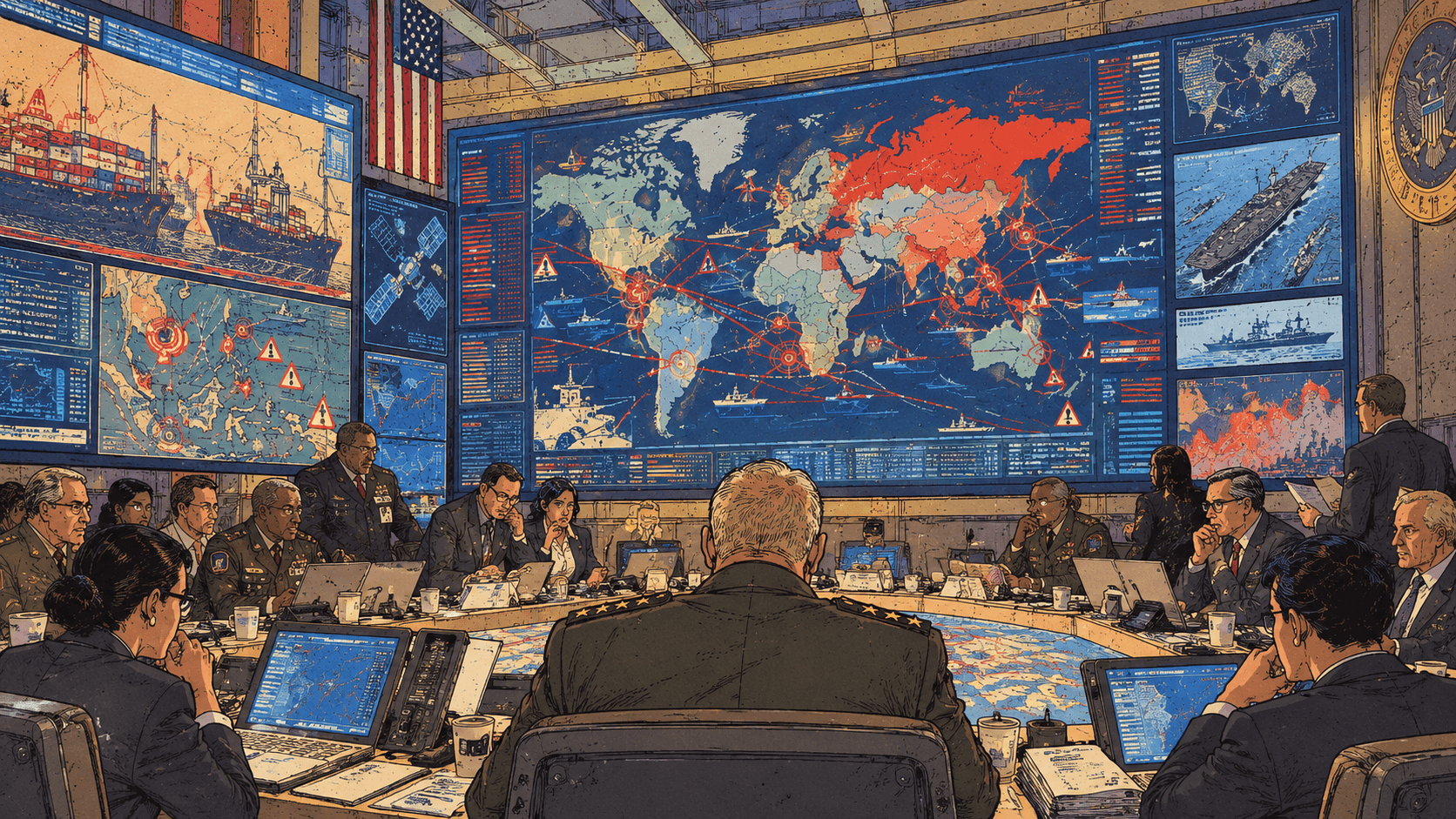
The fluorescent lights of the Pentagon SCIF hummed with aggressive persistence, casting a cool sapphire glow over twenty experts trapped in a U-shaped loop of digital apocalypse.
On screen, the simulated timeline read October 14, 2030. The red cell, driven by a machine-learning engine that modeled Beijing's and Moscow's strategic reflexes, had just executed a devastating maneuver. They weaponized the global maritime logistics flow. By executing a coordinated, deniable blockade of critical semiconductor testing facilities in Southeast Asia and introducing logic-bomb malware into commercial shipping manifest systems, they caused an immediate, paralyzing bottleneck in Western defense manufacturing.
General Marcus Sterling sat at the apex of the horseshoe of desks, watching the cascade of pixels turn amber, then red. He ignored the numbers. He knew them by heart. For fifteen years, spanning three administrations, Sterling had sat in rooms precisely like this one, watching the finest minds in the national security apparatus play a losing hand.
"We are shifting to Response Option Bravo," a civilian analyst announced from the right flank. "Redirecting a carrier strike group to break the maritime shipping logjam and initiating forward interdiction."
The AI did not hesitate. It never did. The screen flickered. A localized kinetic clash over access to the shipping lanes in the Luzon Strait triggered conventional escalation. Six minutes later, a tactical nuclear exchange initiated over the Baltic to relieve pressure on European maritime ports. Three minutes after that, the simulation terminated in a blinding flash of white text: Strategic Exchange Initiated. Total Attrition. Simulation Ends.
"Reset the board," Sterling said. His voice was too quiet for a man of his size.
The digital map wiped clean, reverting to the uneasy peace of the morning—the ninety-fourth time this month the world had reset after dissolving into ash.
For a decade and a half, the calculus had remained stubborn and unyielding. Any attempt to use America's massive, industrial-age military might to halt autocratic expansion resulted in nuclear Armageddon. Yet, whenever the simulation parameters dictated caution, the alternative was merely a slower, quieter death. Left to the status quo, Russia and China used a relentless cocktail of irregular war, supply chain disruption, cognitive warfare, financial sabotage, lawfare, and poison-pen diplomacy to hollow out Western alliances from the inside.
If Washington fought, the world ended. If Washington desisted, the West dissolved.
"Let us look at the structural variables in the third quadrant," Dr. Aris Thorne said, adjusting his glasses. Thorne was a permanent fixture of the Beltway ecosystem, a man who had made a lucrative career out of explaining why American foreign policy was always just one minor adjustment away from perfection. "The AI is over-indexing on the adversary's risk tolerance. If we reduce it—"
Sterling slammed his palm onto the mahogany table. The strike was sudden, loud, and heavy enough to make the water glasses rattle.
"This is the definition of insanity," Sterling growled.
"General, the predictive modeling requires nuance," Thorne replied, offering a smooth, practiced smile. "We are dealing with an unprecedented fusion of hybrid threats. The data suggests—"
"The data suggests we are idiots," Sterling cut him off, leaning forward until his chest pressed against the edge of the table. He looked like a relic of an era that built strategic bombers rather than algorithms. "We have run this problem through every supercomputer from Maryland to California. We have war-gamed it to death from INDOPACOM to NATO. We have changed the leadership variables and every other variable. And every single time, we either light the match or we let them pick our pockets until we are bankrupt and defenseless."
"We are managing a multi-layered transition period," a Deputy Assistant Secretary from the State Department offered softly. "Containment in the twenty-first century looks different. We are living in the most complex time in history."
"It looks like losing," Sterling shot back. "And life today is no more complex than in Julius Caesar's time, or Martin Luther's, or World War Two."
He scanned the faces around the table. Most retreated into the safety of their tablets and bureaucratic jargon. A distinct minority kept their eyes fixed on the general. They had the hollow look of people who had finally seen through the fog of peace.
"We are paradigm prisoners," murmured Dr. Elena Reyes, a historian brought in to model adversary societal resilience. "Look at us. We are trying to win a game when we do not even know what winning looks like anymore. We're deploying carrier groups like it's the Battle of Midway when China has already penetrated our society with disinformation about why we even fight."
"There is nothing more powerful on earth than a carrier strike group," Rear Admiral Hayes said, his tone snide. "Nothing can match its firepower or withstand its technology. We have the greatest military in the world. We just need to use it properly."
"If our military is so great and our tech so powerful, then why haven't we won a major war since 1945? We lose to guys in flip-flops carrying AK-47s and driving pickup trucks. It's sadly become the American military tradition."
Hayes's face hardened, his jaw tightening as he self-censored.
"The problem is conceptual," Sterling bellowed. "We are using twenty-first-century technology to execute twentieth-century strategic thinking." He glanced down at Hayes. "War changes before warriors do. Our adversaries do not want to plant their flag on our soil. They want to rot our foundations until the roof collapses on its own."
The room fell silent. It was the kind of silence that occurs when someone finally names the ghost in the house. For decades, the American security state had relied on a simple formula: more money, more technology, and more firepower equaled victory, no matter the adversary. The blob—Washington's national security groupthinkers—gave it fancy names like The Revolution in Military Affairs or the Third Offset Strategy. It was all the rage in peer-reviewed journals and Beltway cocktail parties for years.
But the enemy gets a vote too, and they bypassed those assumptions entirely. They infiltrated the democratic bloodstream, turning open societies against themselves through targeted disinformation, compromised elites, and economic dependency. It was a cancer, slow and systemic.
"She is correct," Sterling added, his voice dropping an octave. "We do not know how to fight this. Worse, we do not know how to win. Our entire doctrine is built around a decisive battle that will never happen, because the moment it does, everyone dies. We are entirely flat-footed."
Sterling killed the main screens with a single, sharp keystroke, leaving only blinking red text against the black: Simulation Ends. He stood up, surveying the room with a look that could melt glass. "World War Three is nuclear, and World War Four is sticks and stones. If that is the case, we have to skip the apocalypse entirely. We need to skip straight to World War Five."
A voice from the back broke the silence. "And what exactly is World War Five?"
"Waging war while convincing the enemy it is peace," Sterling said. "Until it is too late for them to react. Victory is a boiled frog."
The room rippled with confusion and skepticism.
"How?" another voice asked.
Thorne cut in before Sterling could answer. "General, with all due respect"—the military equivalent of a middle finger—"that makes no sense. How do you fight World War Five without crossing the nuclear threshold of World War Three?"
"By masking the conflict as peace until the trap snaps shut. It is exactly what they are doing to us."
Ambassador Healy shifted, his voice dripping with diplomatic balm. "But Marcus, surely you are not serious. If we adopt their tactics, we lose our identity. There becomes no difference between us and them."
"There is only winning and losing, Ambassador. Is it truly better to lose honorably than win dishonorably? No."
Healy sank back into his leather chair.
Reyes leaned forward, eyes locked on the General. "How do we fight World War Five?"
"World War Five is fought in the market indices, the neural pathways, and the shadows," Sterling said, leaning over the table. "It is a conflict of invisible leverage and quiet sabotage, where the enemy collapses from within before they even realize a shot has been fired. We hold the world's strongest economy, yet we refuse to weaponize it. We invented Hollywood and Madison Avenue, yet our cognitive warfare capabilities are laughable. We possess the finest covert operatives and cyber tools on earth, but we pull punches in the shadows while our adversaries unleash social combustion in our streets. If we are to prevail, we must muster all our instruments of power, not just the ones that shoot bullets."
The words hung in the silence.
"Sneaky war," the CIA officer mused, leaning back. "I like it. You are suggesting we ramp up trade wars, psychological operations, and use the dark arts to engineer an autocracy's capitulation. It is cheap, we can start tomorrow, and it beats refighting World War Two every day."
"You will only create a mess that the State Department has to clean up for decades," the Ambassador shot back.
"Enough," Sterling snapped. "It is more than sneaky war. We need new forms of deterrence, economic fusion with modern tech, and a diplomatic alliance structure that reaches across the public and private sectors." He sat down, the anger draining into exhaustion. "We need thinking that changes the game board. We won't know our own leverage until we map it out. The only certainty in this room is that our current playbook leaves us defenseless against..." He gestured to the dead wargaming screens. "...this."
"And you will not find it inside Washington," said Admiral Cole, the Vice Chairman of the Joint Chiefs, who had sat as an observer in the back of the room. He had remained quiet until now. His gaze met Thorne with cold clarity. "The Beltway is a closed loop. We recruit the same people from the same universities to write the same memos for the same committees. We train our analysts to all think the same, and our commanders to react the same. We have devolved into a monoculture of confirmation bias, engineering our own strategic failure. If the answer were inside Washington, we would have found it years ago."
Cole stood up, walking to the edge of the massive game monitors. "If we want to know how to survive the next twenty years, we need minds that are not corrupted by our funding cycles, our obsession with legacy platforms, or our groupthink. We need people who can see the future because they are not responsible for defending the past."
"Are you suggesting we outsource grand strategy to outsiders?" the Ambassador asked, horrified. "Without clearances? Without vetting? Without experience? Without…anything?"
"I am suggesting a Manhattan Project for the mind," Cole said. "Completely black. Off the books. No congressional oversight to leak it, no defense contractors to monetize it, no bureaucracy to strangle it. It is outside the chain of command, and answers to us. Or, rather, me."
"The Manhattan Project built a bomb to end a conventional war," Thorne countered. "What are these outsiders supposed to build?"
"An intellectual survival map," Sterling said, stepping back in. "We need them to inhabit the 2050s. To look back at our present from twenty-five years in the future and expose our blind spots. They must figure out how to push nuclear autocracies back into their cages without igniting World War Three. We need new concepts and platforms that win this war without firing a shot, instead of the bureaucratic inertia we rely on now. We need them to send those answers back to us from 2050, before we run out of time."
"In other words, we get creative," added Cole. "We need innovation of strategic thought."
The room of senior leaders looked at one another. The proposition sounded like madness, a desperate gamble born of intellectual exhaustion. Yet, the red text on the screens remained: Simulation Ends. The existing system had nothing left to offer but the same recurring nightmare.
"How do you even begin to organize something like that?" the Ambassador asked. "If you do not want strategists, who do you want?"
"Innovators. Critical thinkers. Contrarians. Independent minds. Cassandras," said Cole.
The CIA representative looked confused.
"Cassandra's Curse," said Reyes to the CIA officer. "The Trojan princess who warned her people not to drag the wooden horse inside the city gates. The gods gave her the gift of prophecy but cursed her so that no one would ever believe her." The CIA guy nodded his thanks.
"Thinkers," Sterling said simply. "Historians and classicists who understand human nature. Science fiction authors who understand technology's rot. Economists who look at black markets rather than the stock exchange. Smart people who possess imagination instead of a security clearance. Founders and short-sellers who understand the systemic vulnerabilities of future markets."
"Fine. But how do we merge their wisdom," the Ambassador said, dropping heavy air quotes, "into the harsh realities of international relations—a full-contact sport."
"We pair them up with you," Sterling said with a flash of steel. "And others like us. But they drive the solution, not you or me."
The Ambassador's poker face broke into revulsion. "You can put me in the same room as a tech whiz kid, but that's not fusion. That's two people speaking different languages."
The room fell silent, empty of ideas.
"Writers," Reyes said, and all heads swiveled toward her. "We find good writers. The ones who can listen, ingest complex ideas, and spit out a digestible version. You know, make it go down like ice cream."
"Journalists are poison," Hayes spat. "They twist everything."
"We don't hire journalists, we hire writers," Reyes replied. "And some journalists are also writers."
"Let's follow her heading," Cole added. "We build a core team to hunt, recruit, and handle these minds, then bring in writers to capture the vision. Give them a real problem and demand a solution. We feed them the unvarnished data of our failures, classified intelligence if necessary, and order them to write the history of how we survived. We put that out into the universe, see what comes back, and use their fiction to build our reality."
"Useful fiction," Reyes murmured.
"An oxymoron," Hayes scoffed.
"No," Reyes countered, her voice hardening. "The future. It forces us to look directly at the blind spots we ignore by choice. Even if it only shows us how to survive our own stagnation, it beats the alternative."
The room cooled as the weight of the decision settled. It was an admission of total bankruptcy, a confession that the multibillion-dollar security apparatus had run completely out of ideas. Yet it was also the first spark of genuine novelty to enter the SCIF in years.
"An agency of imagination," Reyes mused, leaning back. "A department for unconventional thinking."
"A bureau," Sterling corrected. His eyes reflected the cold blue light of the reset simulation screen as he stared at the empty digital map, waiting for the next inevitable failure, determined to break the loop. "We will call it the Fiction Bureau."