THE RECRUIT
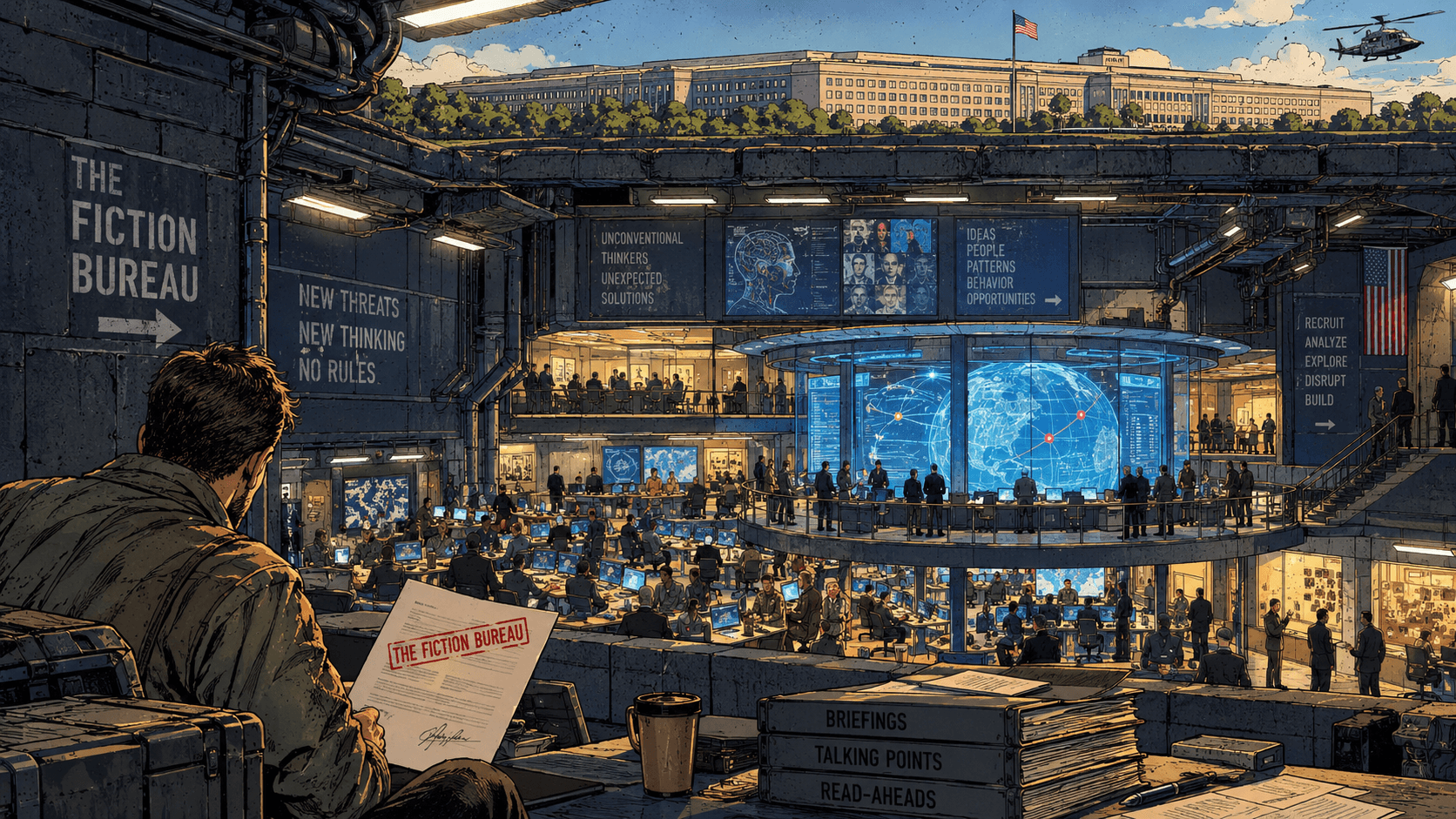
The Commander's Action Group occupies a subterranean vault beneath the Pentagon's E-Ring, squeezed between a maintenance closet and an unmapped utility shaft. On paper, the CAG is an elite strategic skunkworks—a sanctuary where high-performing officers shape policy for four-star leadership.
In reality, it is a gilded graveyard where ambitious officers suffocate under an avalanche of talking points, slide decks, and read-ahead binders. A Green Beret with an Ivy League doctorate does not belong here. Yet after years of parachuting, covert night raids, and foolishly believing intellectual rigor might improve military strategy, Colonel Steve McCrae found himself exiled to this windowless mausoleum, drowning in bureaucratic jargon.
He had come off a Special Mission Unit command in Iran straight to a desk that smelled faintly of damp concrete and instant coffee. In hindsight, his sins were obvious: he read too much, spoke too clearly, and asked disruptive questions.
When General Vance summoned him late in the afternoon, McCrae expected routine indignities—another hundred-page briefing paper or an urgent draft for a meeting about a meeting.
Instead, the General handed him a single sheet of paper with no classification markings, no control number, and no tracking barcode. In the Pentagon's machine, a memo without a paper trail was a ghost.
"Read it," Vance said, leaning back in his leather chair, dull overhead light reflecting off his four stars.
McCrae scanned the document. It was brief, precise, and completely surreal. The page carved out an off-books operation reporting straight to Vance's executive authority, with no Program Element and no footprint in the standard budget cycle. It gave the bearer total clearance to requisition personnel, access black sites, and blow through standard chains of command, authenticated solely by Vance's wet signature and a direct line to his pocket phone.
"The Fiction Bureau," Vance said quietly.
McCrae looked up, waiting for the punchline. As a young paratrooper in the 82nd Airborne, his NCOs sent him to search for a box of grid squares and an artillery silencer. He knew what a prank looked like. Vance was not smiling.
"Sir," McCrae said carefully, testing the room's oxygen. "Is this a joke?"
"Do I look like I'm having a gas at your expense, Colonel?" Vance's voice dropped an octave. "The Pentagon is ossified. Our doctrine is written for wars we will never fight again. Our wargames are rigged to ensure our battle fleets always win, right up until the day they don't."
He leaned back, his eyes drifting past McCrae toward the back wall. McCrae instinctively glanced over his shoulder, finding only a framed portrait of Marshall staring back.
"We are getting out-thought by enemies with a fraction of our budget," Vance said, his gaze locking back on McCrae. "They win because they ignore our rules and exploit our administrative straitjackets. I need minds that imagine the catastrophe before it lands. I need a team that writes the future before our adversaries force us to live it. By the time a threat hits the news, we have already lost."
McCrae had never seen a mandate like it. "Will this become a Program of Record? Or an unacknowledged Special Access Program?"
"God no," Vance snapped. "Programs of Record attract committees, auditors, and defense contractors with lobbyists. SAPs are no better—trapped under armed guards and layers of red tape. It's where good ideas go to die a slow, agonizing death."
"Then what is this, sir?"
"It's a Program of Unrecord. It doesn't exist. If anyone asks, you're drafting speech notes for my Tampa symposium. Report only to me." Vance nodded at the memo in McCrae's hand. "There's your blank check. Now go build it."
Clandestine, McCrae thought. Not from foreign spies, but from the Pentagon's own bureaucracy.
Twenty minutes later, McCrae sat in the Pentagon's five-acre courtyard, the patch of grass Cold Warriors nicknamed Ground Zero. At its center stood no secret bunker entrance, just a sandwich shop. He gnawed a stale hoagie and watched squirrels chase each other across the lawn. Targeted by Soviet ICBMs for half a century, it had become the safest squirrel preserve on the planet.
"Hey, snake eater!"
Jack crossed the grass, grinning. A former teammate from Joint Special Operations Command, Jack had traded field gear for intelligence analysis, burning his hours in the bureaucracy at his family's demand. McCrae had called him the second he left Vance's office. He needed perspective.
"You look like you just saw a ghost, Steve," Jack said, sitting down.
"Worse," McCrae said. "I just got handed the keys to the kingdom, and I have no idea where the front door is."
McCrae skipped the memo, sketching the directive in broad, careful strokes. No oversight. Direct access. Total latitude to recruit anyone from anywhere to build a strategic forecasting engine immune to Washington herd think. Qualitative vision over quantitative modeling.
Jack stared, then let out a sharp, barking laugh that turned the heads of two passing Navy captains.
"You serious?" Jack guffawed.
McCrae's stare remained cold.
"Alright, alright," Jack said, wiping his eye. "Can't be harder than taking out bin Laden." He cracked up again.
"Come back to earth, Jack. I need help here," McCrae said.
Jack settled, leaning back against the bench. "So what's step one? Hit the university circuit? Scour think tanks for bow ties writing white papers on hybrid warfare? Pitch an idea in Foreign Affairs? Complete waste of time."
"I don't need policy analysts spending six months debating definitions and authorities," McCrae said. "Besides, when did their strategic ideas last win a war?"
Neither answered. The silence said enough.
Jack squinted through the evening sun. "So, who do you recruit?"
"We have to think stranger," McCrae said, looking up at the gray monolith surrounding them. "War isn't a math problem. To collapse a regime, skip the political scientists and hire a con artist who exploits mass vanity. To wage economic sabotage, bypass the economists and bring in short-sellers and cartel accountants. To break a rogue network? Put a sci-fi writer in a room with a black-market fixer and a bottle of whiskey. The Building models data because numbers are clean and predictable. We're going to exploit human nature, because war is neither."
"You're talking about pairing visionaries with sociopaths," Jack said. "Creatives with pirates."
"I'm talking about marrying imagination to strategy. Exploring the art of the possible," McCrae said, tapping his coat pocket where the memo sat like a loaded weapon. "No rules, Jack. Only victory versus defeat."
"Sounds great," Jack said. "Good luck, Steve. You'll need it."
"Didn't I mention it, Jack?" McCrae handed him the folded sheet. "You're recruit number two."
Jack stared at the paper. His coffee cup hit the ground, spilling into the grass.
"Drink up," McCrae said, snatching the memo back as he stood. "Vance's memo comes with a C-37 on standby. We have a flight to catch, and a few bad influences to find."
Jack looked at the empty cup, then up at McCrae's back. A slow grin spread across his face. "Lead the way."